Sozo-Technologies-GmbH.png)

AI × DX: Redefining
How Global Business Drives Profit
Strengthen governance.
Boost productivity.
Build a smarter global enterprise.
Message

What Makes a Company Succeed Overseas
In recent years, while globalization continues to expand, the barriers to cross-border business development are growing due to differences in local customs, evolving global dynamics, and changing legal frameworks.
On the other hand, even among globalizing Japanese companies, there are companies that have achieved unique development and have succeeded in overseas business.
They have strong management skills to visualize and overcome potential local issues that are difficult to see from the Japanese head office, as well as superficial issues such as differences in language and local customs that can become barriers in overseas business. I’m here.
However, for local subsidiaries with limited management resources, having the capacity to visualize issues, quantify them, and develop effective countermeasures is an extremely challenging task.
This is why strengthening local management capabilities at the subsidiary level—rather than simply tightening oversight from headquarters—is essential.
We develop core systems tailored to the specific challenges of each overseas subsidiary, empowering local management through digital transformation (DX).
Our mission is to enhance the productivity, talent acquisition, and management capabilities of overseas offices—creating the best possible working environments for Japanese companies and helping them thrive on the global stage.
Common Issues for Overseas Offices
Challenges in Business Growth
Employment Risk
High risk of hiring local employees.
High Personnel Expenses
Slow Business Development
Business promotion through local M&A takes time to visualize the business and market.
Difficulty Identifying Core Issues
Local customs create barriers to data collection, making it difficult to identify the root causes of problems.
Time-Consuming Handovers
After transitioning from a predecessor, it takes considerable time before essential insights become available.
Challenges in Reporting
Core Business Under Pressure
Reporting to headquarters and compliance demands leave little bandwidth for core business activities.
Insufficient Staffing
Balancing business development with compliance requires additional staff, but budget constraints make this difficult.
Time Constraints
Organizing internal data and preparing reports in the required formats consumes excessive time.
Travel Restrictions
Document reviews and report preparation around deadlines prevent employees from traveling for business.
Challenges for DX at Overseas Offices
Lack of IT Expertise
No in-house staff with the expertise to plan and manage system implementations, stalling DX progress.
Language Barriers
Local systems introduced in unfamiliar languages increase the burden on expatriates and staff, creating inefficiency.
Optimization
Head office systems are not optimized for local operations, limiting efficiency gains.
Lack of Specialized Personnel
Lack of employees capable of system planning and implementation management.
Challenges in Business Growth
Employment Risk
High employment risk。
High labor costs。
Slow Business Development
Building a business from scratch or through local M&A requires significant time to map out the market landscape.
Difficulty Identifying Core Issues
Local customs create barriers to data collection, making it difficult to identify the root causes of problems.
Time-Consuming Handovers
After transitioning from a predecessor, it takes considerable time before essential insights become available.
Challenges in Reporting
Core Business Under Pressure
Reporting to headquarters and compliance demands leave little bandwidth for core business activities.
Insufficient Staffing
Balancing business development with compliance requires additional staff, but budget constraints make this difficult.
Time Constraints
Organizing internal data and preparing reports in the required formats consumes excessive time.
Travel Restrictions
Document reviews and report preparation around deadlines prevent employees from traveling for business.
Challenges for DX at Overseas Offices
Language Barriers
Local systems introduced in unfamiliar languages increase the burden on expatriates and staff, creating inefficiency.
Local Optimization Gap
Head office systems are not optimized for local operations, limiting efficiency gains.
System Fragmentation
Multiple fragmented systems increase the administrative burden on IT managers.
Poor Usability
Rapidly adopted remote work tools proved difficult to use effectively.
By solving these problems with “RUNZUS”…
Improve local productivity and lead to overseas business promotion.
RUNZUS Series

CUSTOMIZED FOR YOUR COMPANY

Features of RUNZUS
One-Stop Service
Consolidate all operations into a single platform, reducing administrative overhead. This enables you to visualize business performance and cost structures, driving toward a more efficient revenue model.

95-Language Translation & Multi-Currency Support
Minimize language-related friction for expatriates and local staff alike.
l Real-time information management, even with changes in social conditions such as Ukraine,
COVID-19, etc.

Mobile-Ready Operations
Access, review, and approve information in real time from your smartphone—anywhere, anytime. Stay focused on core business without being tied to a desk.

Data Entry Optimization
Our unique technology completely renews the system environment, which has been a problem in input work, and reduces input work time by about 30 to 50%.
In addition, by using the data entry service, the data entry work itself can be reduced.

Custom Branding for Your Company
A platform branded exclusively for your company enhances employee loyalty and engagement.

Access Control & Data Security
Precisely control access to sensitive data, including personal information.

95 Languages Supported
- Japanese
- English
- Afrikaans
- Albanian
- Amharic
- Arabic
- Armenian
- Azerbaijani
- Basque
- Bengali
- Bulgarian
- Burmese
- Belarusian
- Cambodian
- Catalan
- Chinese
- Corsican
- Croatian
- Czech
- Danish
- Dutch
- Esperanto
- Estonian
- Persian
- Finnish
- French
- Frisian
- Galician
- Gaelic (Scottish)
- Georgian
- German
- Greek
- Gujarati
- Hausa
- Hebrew
- Hindi
- Hungarian
- Icelandic
- Indonesian
- Irish
- Italian
- Kannada
- Kazakh
- Kyrgyz
- Korean
- Lao
- Latin
- Latvian (Lettish)
- Lithuanian
- Macedonian
- Malagasy
- Malay
- Malayalam
- Maltese
- Māori
- Marathi
- Mongolian
- Norwegian
- Oriya
- Pashto
- Polish
- Portuguese
- Punjabi
- Romanian
- Russian
- Samoan
- Serbian
- Sesotho
- Shona
- Sindhi
- Sinhala
- Slovak
- Slovenian
- Spanish
- Sundanese
- Swahili (Kiswahili)
- Swedish
- Tagalog
- Tajik
- Tamil
- Tatar
- Telugu
- Thai
- Turkish
- Turkmen
- Uighur
- Ukrainian
- Urdu
- Uzbek
- Vietnamese
- Welsh
- Kosa
- Yiddish
- Yoruba
- Zulu
* Blue icons = EU member states
- 日本語
- 英語
- アフリカーンス語
- アルバニア語
- アムハラ語
- アラビア語
- アルメニア語
- アゼルバイジャン語
- バスク語
- ベンガル語
- ブルガリア語
- ビルマ語
- 白ロシア語(ベラルーシ語)
- カンボジア語
- カタラン語
- 中国語
- コルシカ語
- クロアチア語
- チェコ語
- デンマーク語
- オランダ語
- エスペラント語
- エストニア語
- ペルシャ語
- フィンランド語
- フランス語
- フリジア語
- ガリシア語
- ゲール語(スコットランド語)
- グルジア語
- ドイツ語
- ギリシャ語
- グジャラート語
- ハウサ語
- ヘブライ語
- ヒンディー語
- ハンガリー語
- アイスランド語
- インドネシア語
- アイルランド語
- イタリア語
- カンナダ語
- カザフ語
- キルギス語
- 韓国語
- ラオス語
- ラテン語
- ラトビア語(レット語)
- リトアニア語
- マケドニア語
- マダガスカル語
- マレー語
- マラヤーラム語
- マルタ語
- マオリ語
- マラーティー語
- モンゴル語
- ノルウェー語
- オリヤー語
- パシト語(パシュトー語)
- ポーランド語
- ポルトガル語
- パンジャブ語
- ルーマニア語
- ロシア語
- サモア語
- セルビア語
- セソト語
- ショナ語
- シンド語
- シンハラ語
- スロバキア語
- スロベニア語
- スペイン語
- スンダ語
- スワヒリ語(キスワヒリ語)
- スウェーデン語
- タガログ語
- タジク語
- タミル語
- タタール語
- テルグ語
- タイ語
- トルコ語
- トルクメン語
- ウイグル語
- ウクライナ語
- ウルドゥー語
- ウズベク語
- ベトナム語
- ウェールズ語
- コーサ語
- イディッシュ語
- ヨルバ語
- ズールー語
※ 青いアイコン = EU加盟国
Effects of Introducing RUNZUS
Streamline Analog Tasks: Manual Input, Transcription & Reconciliation
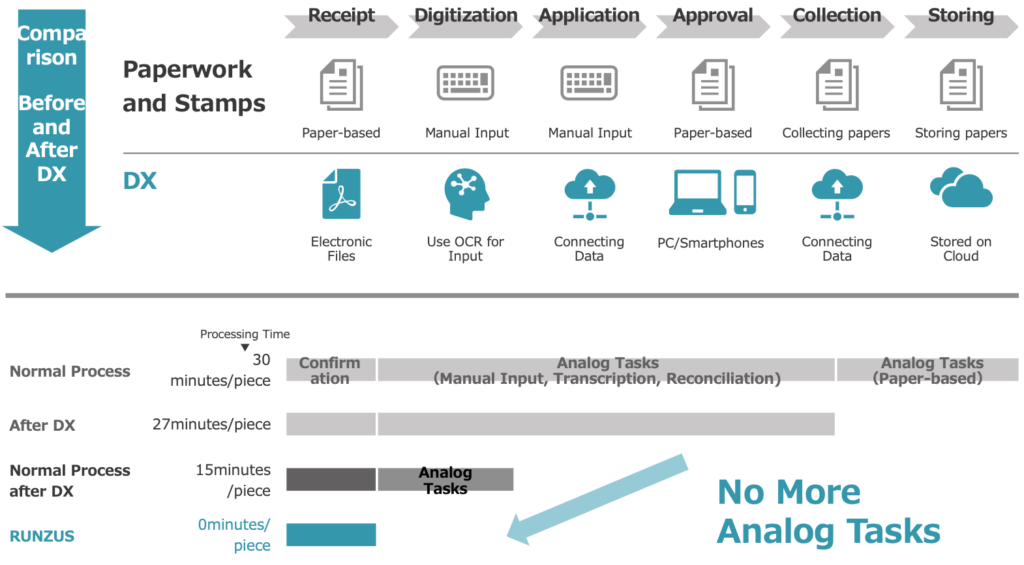
In the past, paper and stamps were the mainstream of business.
Everything from confirmation to work was done manually, and there was a lot of work to do face-to-face with the client.
Of course, there are some things that can only be conveyed by hand or face-to-face.
However, driven by environmental responsibility, evolving work practices, and shifting global dynamics, the digitalization of business will only continue to accelerate.
Digital transformation offers numerous advantages.
Significantly reduce material costs and labor costs.
At the same time, it frees up valuable time for expatriate managers, allowing them to focus on the work that truly matters.
RUNZUS minimizes analog tasks as much as possible, paving the way for overseas office success.
Best practice
Engineering Service Company
Indirect Cost Visualization Achieved €54,000 in Annual Savings
- Rising fuel costs have also driven up overhead costs, such as expenses for employees traveling by car.
- There was a gap in cost awareness among sales and engineering employees, leading to widespread dissatisfaction.
- Visualization of expenses per number of visits and mileage for each employee
Fostering cost-consciousness among employees by discouraging the use of expensive parking lots and encouraging the use of stores with low fuel costs
- Average monthly savings of €500 per employee across 9 staff members, totaling €4,500/month (€54,000/year).
Core System Development
Cutting-Edge Technology
Leveraging AI, OCR, NFC scanning, and our proprietary parallel input system to build optimal solutions for your company.
Multilingual, Multi-Currency, Auto-Translation & Data Entry Support
As a one-stop provider of overseas office systems, we address your specific needs while expanding the scope of simplification and automation—driving DX initiatives that were previously stalled by language barriers.
Designed by Expatriates and Operations Experts
Development by professionals with extensive knowledge of business site issues and business design *Expatriates with experience stationed in 2 overseas countries, management experience at 10 sites, staff with experience in SaaS development and sales for enterprises, etc.
Flexible Development Approach
Development of a highly convenient and scalable system considering future partial modifications
Other Companies:Requirement definition → Development → Acceptance inspection → Delivery → Maintenance
(*In some cases, it may be difficult to handle additional modifications)
Our Company:Requirement definition → Development → Small start → Partial modification → Acceptance inspection → Delivery → Maintenance
About Us
Sozo Technologies GmbH
Oskar-von-Miller-Ring 20, 80333 München
www.sozo-technologies.com/en
+49 (0)89 2017 5111
sozo-sales@sozo-technologies.com
Operational Efficiency as Employee Benefits
Focus on Core Work and Boost Employee Motivation
The terms “DX” and “digitalization” can sometimes evoke images of cost-cutting or job displacement. In reality, operational efficiency not only reduces the workload for both managers and employees—it also serves as a form of employee benefit that drives greater job satisfaction.
Traditional benefits programs typically involve increasing spending or reducing work hours. However, instead of relying on measures that tend to become routine, the time freed up through efficiency gains can foster new internal communication and give employees breathing room—leading to sustained improvements in satisfaction.
Many of the things employees value most today—better work-life balance, flexible work locations—can be achieved through efficiency improvements that remove constraints on when and where they work.
Furthermore, higher employee satisfaction leads to lower turnover, reduced recruiting and training costs, and ultimately improved business performance.
Therefore, operational efficiency is not just about cutting costs—it is a genuine benefit program for your employees.